
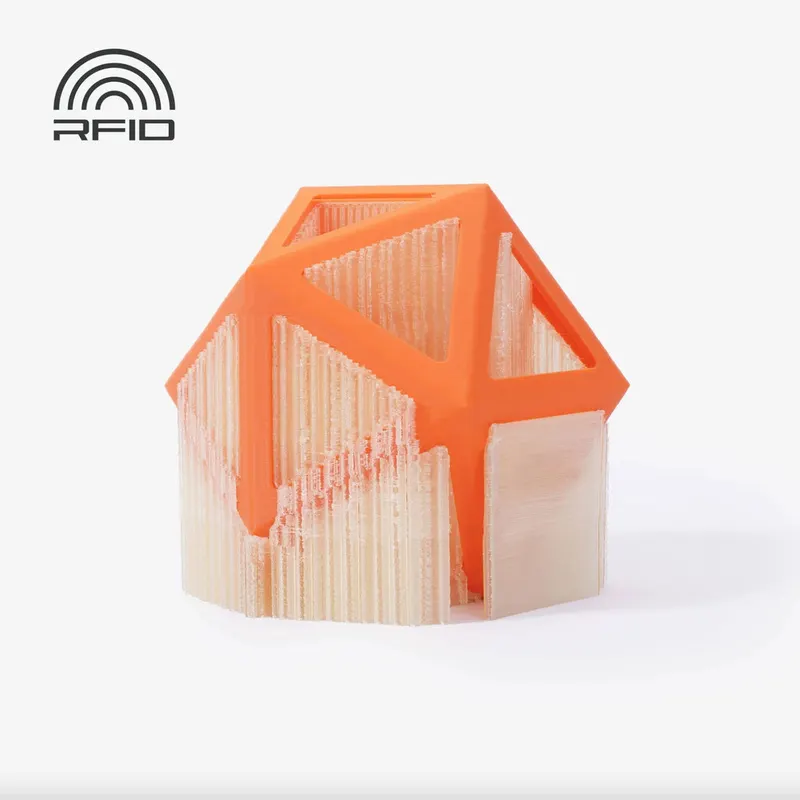
Bambu Lab PVA Clear 0,5 kg
Product details
- Brand:
- Bambu Lab
- Category:
- Filament
Product description
Product Description
Bambu Lab PVA Clear is a high-quality water-soluble support filament developed specifically for 3D printing complex models with complicated geometry, cavities, and overhangs. After printing, the PVA supports are simply dissolved in water, which eliminates tedious mechanical removal of supports and minimizes the risk of damaging the surface of the main model.
PVA Clear is supplied on a reusable Bambu Lab spool, contains an RFID chip for automatic material detection in AMS and optimization of print profiles in Bambu Studio. This significantly simplifies setup and ensures repeatable results.
Main Features
- Water-soluble support material – ideal for complex overhangs, internal cavities, and geometry where standard supports cannot reach.
- Compatible with PLA, PETG, PLA-CF/GF, PETG-CF/GF – perfect choice for multi-material printing.
- Clean support interface surfaces – PVA fills the support interface, so after dissolution, a smooth surface remains without damage to the main model.
- Optimized for Bambu Lab printers – complete profile in Bambu Studio, AMS/AMS Lite support, RFID material identification.
- Filament diameter 1.75 mm ± 0.03 mm – stable material flow and reliable printing.
- Moisture sensitive – suitable for dry boxes and AMS – for trouble-free printing, it is necessary to keep PVA dry.
Recommended Use
- Printing highly detailed models where mechanical removal of supports would be difficult or impossible.
- Functional prototypes with internal channels, channels for liquids, air, or cabling.
- Multi-material prints (PLA/PETG + PVA) on Bambu Lab printers with AMS or dual-extruder systems.
After printing, simply submerge the model in a container of water (warmer water will speed up the process) and let the PVA supports gradually dissolve. The result is a clean model without support residue even in hard-to-reach places.
Printing Recommendations
- Nozzle temperature: 220–250 °C
- Bed temperature: 35–45 °C (with glue / adhesive)
- Recommended print speed: up to 200 mm/s
- Filament drying before printing: approx. 80 °C for 10–12 hours
- Storage: dry, ideally in a closed container or dryer with low humidity (RH < 20%).
PVA is not suitable for printing as a standalone construction material – it is intended primarily as a support filament in combination with another base material.
Technical Specifications
| Parameter | Value |
|---|---|
| Material | PVA (polyvinyl alcohol) |
| Filament diameter | 1.75 mm |
| Diameter tolerance | ± 0.03 mm |
| Spool weight | 0.5 kg |
| Density | 1.27 g/cm³ |
| Printing temperature (nozzle) | 220–250 °C |
| Bed temperature (with glue) | 35–45 °C |
| Recommended print speed | < 200 mm/s |
| Melting point | approx. 202 °C |
| MFI (190 °C / 2.16 kg) | 7.2 ± 1.1 g/10 min |
| Solubility | fully water-soluble |
| Compatible materials | PLA, PETG, PLA-CF/GF, PETG-CF/GF |
| AMS / AMS Lite compatibility | Yes |
| RFID chip on spool | Yes |
User Benefits
- Time saving during post-processing – no risky peeling of supports, less sanding and finishing.
- Higher surface quality – especially in visible areas where standard supports would leave marks.
- Simpler model design – you can afford more complex shapes and internal structures.
- Integration into the Bambu Lab ecosystem – ready-made profiles, automatic material recognition, reliable results.
Bambu Lab PVA Clear is the ideal choice for all Bambu Lab printer users who want to take multi-material printing to a professional level while simplifying the final processing of prints.
Key Features:
- Water-soluble support filament for complex 3D prints
- Compatible with PLA, PETG, and their composite variants (CF/GF)
- Clean and smooth support interface surfaces after PVA dissolution
- Optimized profiles for Bambu Lab printers and Bambu Studio software
- Full compatibility with AMS / AMS Lite, spool with RFID chip
- Diameter 1.75 mm with precise tolerance ± 0.03 mm for reliable printing
- Suitable for detailed, internally hollow, and otherwise difficult-to-support models


